


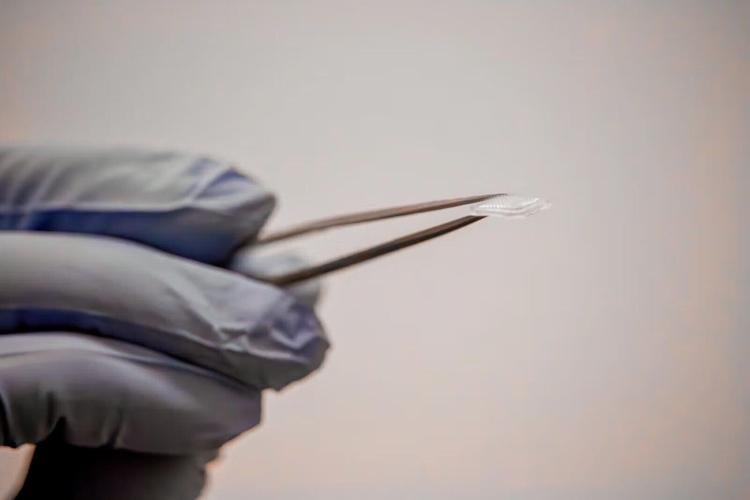


The wearable device uses microscopic polymer needles that penetrate just beneath the skin, without reaching nerves or blood vessels. (Angelica Marie Sanchez / University via SWNS)
By Stephen Beech
A new wearable sensor can detect “silent” heart damage after surgery.
The tiny device has been designed to spot hidden heart injuries in patients days after going under the knife.
It continuously measures cardiac troponin — a protein released when the heart is injured, using a patch loaded with tiny, painless microneedles that sample fluid beneath the skin.
Canadian scientists who designed the device, described in the journal Science Advances, say it offers a new way to monitor patients after they leave the hospital.
Around 300 million people undergo noncardiac surgery each year, and increasing numbers of people are discharged the same day.
But the days immediately following surgery remain a period of elevated danger, with around one in five higher-risk patients experiencing myocardial injury after noncardiac surgery.
And most of those cases occur without obvious symptoms.

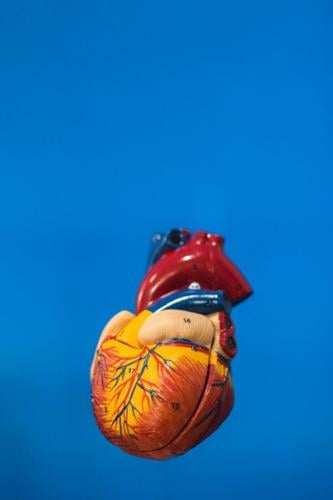
(Photo by Yasser Hernandez via Pexels)
Study leader Leyla Soleymani said: “About 90% of these cases are silent.
“The only way to diagnose many of them is through a blood test, which is difficult when patients are already home.
“We wanted to develop a way to continuously monitor for heart injuries without requiring repeated blood draws.”
She explained that the wearable device uses microscopic polymer needles that penetrate just beneath the skin, without reaching nerves or blood vessels.
The microneedles collect interstitial fluid, the liquid that surrounds cells, and deliver it to a biosensor that’s able to continuously track cardiac troponin levels over several days.
While continuous monitoring technology already exists for biomarkers including glucose, proteins are much harder to track continuously.

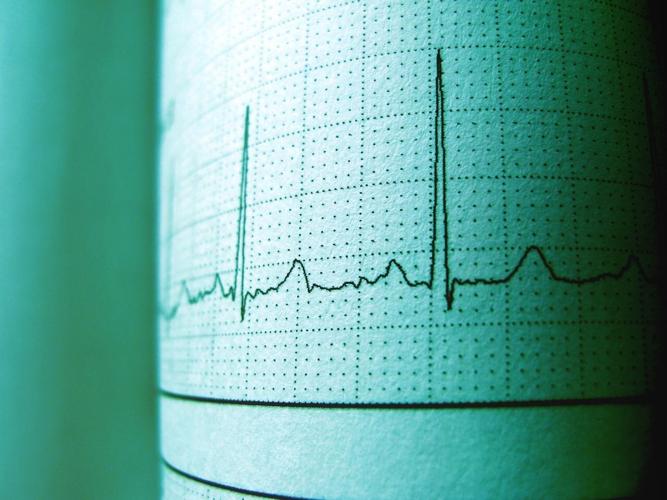
(Photo by kaboompics via Pexels)
Cardiac troponin is present at very low concentrations in bloodstream and becomes even more diluted in the fluid beneath the skin.
Soleymani, of McMaster University, Ontario, said: “That’s what makes this such an important advance.


“We’re monitoring a protein that’s present at very low levels and doing it continuously in living tissue.”
The device builds on previous work by Soleymani and her team in biosensing and aptamer engineering.
Aptamers are short strands of DNA or RNA engineered to recognize specific biological targets.
Earlier versions of the technology monitored smaller molecules such as lactate.
To detect proteins, researchers combined antibodies, which recognize proteins, and aptamers, which generate a measurable signal.
The resulting sensor can continuously track biomarker levels over several days.
Soleymani said: “A lot of different pieces had to come together for this work.
“We had to develop new sensing strategies, create a way to continuously refresh the sensor and integrate everything into a device patients could comfortably wear.”

(Photo by Luan Rezende via Pexels)
The project brought together experts from several Canadian institutions and disciplines.
Researchers at the University of Waterloo developed the microneedle technology that made continuous sampling possible.
Study co-author Mahla Poudineh, whose group pioneered the use of polymeric microneedles for wearable sensing, said: “Creating microneedles that can sample interstitial fluid comfortably and painlessly over extended periods and integrating them with sensing electrodes were a key steps toward continuous wearable sensing,.”
Co-author Bernardo Trigatti, also of McMaster University, helped test the technology in living systems — an important step in showing its potential for future clinical use.
He said: “Testing the device in mouse models of heart disease was an important step toward understanding how it could eventually perform in clinical settings.”
The research team is pursuing commercialization of the device through Aptec Health, a startup founded to help bring the technology to patients.
While the immediate focus is postsurgical monitoring, they say the device could also be used in other areas of medicine such as monitoring health changes in patients between clinic appointments.
Soleymani added: “The future of medicine is personalized, and personalized medicine needs data.
“I like working on hard problems, and I like working on meaningful problems. This one has both.”


(0) comments
Welcome to the discussion.
Log In
Keep it Clean. Please avoid obscene, vulgar, lewd, racist or sexually-oriented language.
PLEASE TURN OFF YOUR CAPS LOCK.
Don't Threaten. Threats of harming another person will not be tolerated.
Be Truthful. Don't knowingly lie about anyone or anything.
Be Nice. No racism, sexism or any sort of -ism that is degrading to another person.
Be Proactive. Use the 'Report' link on each comment to let us know of abusive posts.
Share with Us. We'd love to hear eyewitness accounts, the history behind an article.