


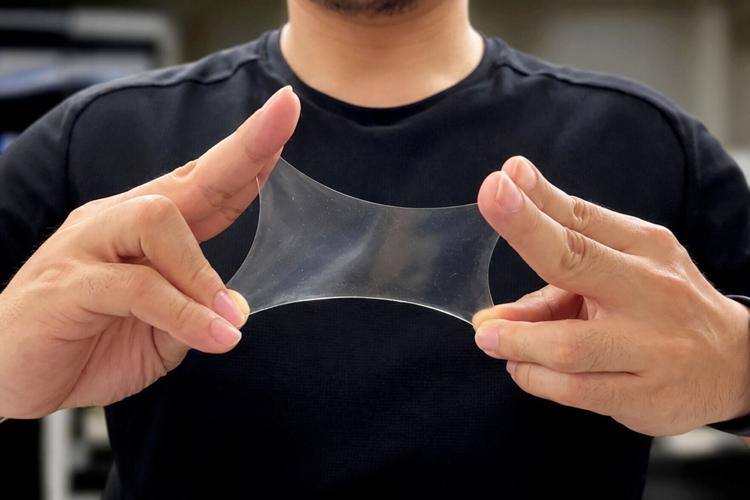


Engineers at MIT and SMART WITEC developed a dry, stretchy material that could eliminate the need for a wet and sticky gel in ultrasound imaging. The rubbery material enabled a wearable ultrasound device to generate clear images over nine days, even during vigorous exercise. (Courtesy Xuanhe Zhao et al via SWNS)
By Stephen Beech
Ultrasound scans could soon be conducted without needing to apply sticky gel.
Scientists have developed a “skin-like” dry material to replace the traditional goopy gel when conducting scans.
They say the new stretchy material will eliminate the need to apply a wet and sticky gel before conducting a scan.
And the team believes it could also be used in future to track athlete performances.
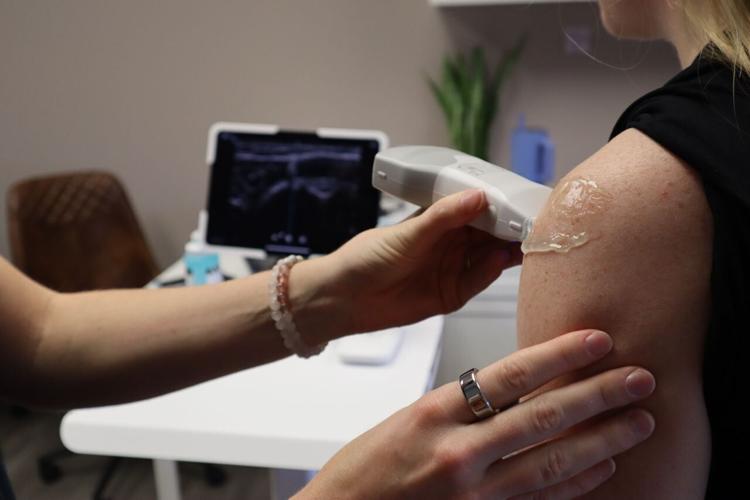
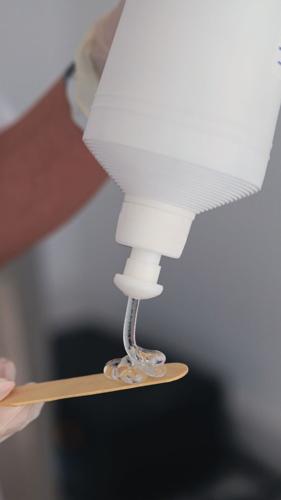
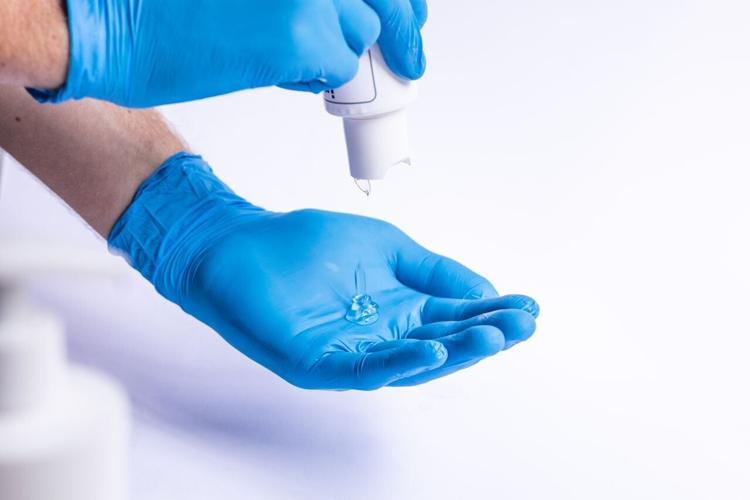
Currently, technicians usually spread a cold gel onto a patient’s skin before imaging the area with an ultrasound probe.
The gel fills in tiny gaps between the probe and the skin so ultrasound waves can travel efficiently through the skin to generate clear images of a patient’s underlying structures.
Engineers at Massachusetts Institute of Technology (MIT) in the U.S. and the Singapore-MIT Alliance for Research and Technology’s Wearable Imaging for Transforming Elderly Care project (SMART WITEC) teamed up for the new project.

(Photo by Carly Dernetz via Pexels)
MIT engineers are designing wearable ultrasound patches that could provide continuous imaging, at home or on the go.
But one sticking point has been the gel.
Their previous designs have included a layer of hydrogel — a mostly water-based material that seals up the space between the skin and a small ultrasound probe.
But within a day or two, the gel can dry out, along with its ability to transmit sound waves.
MIT professor Xuanhe Zhao said: “In a doctor’s office, a technician can simply apply more gel if needed.
“But for a wearable device, gel-based designs can limit their long-term usability.”
Now, the MIT team has developed a liquid-free alternative to gel that efficiently transmits ultrasound waves.
Because the material is dry from the start, Zhao says its performance remains stable over long periods.

(Photo by Yuanda "Darian" Shen via Pexels)
In experiments, the engineers found that the rubbery material enabled a wearable ultrasound device to generate “clear, continuous images” over nine days, even during vigorous exercise.
As a demonstration, the team fixed a small wearable patch, about the size of a key fob, to a volunteer’s neck.
The patch contained a small ultrasound probe, and the dry and stretchy layer that stuck directly to the skin.
The entire patch was connected to a small portable tablet that recorded the patch’s ultrasound images as the volunteer took a 30-minute bike ride.
Study leader Shu Wang, a researcher in MIT’s Department of Mechanical Engineering, said: “We are really aiming to address a material challenge in ultrasound imaging.”
Co-lead author Runze Li said: “If you don’t have a good interface, that will definitely stop you from developing this wearable imaging field.
“This is a very good solution that enables a longer time for imaging.”
They explained that gels and liquids in general are ideal mediums through which sound waves, including ultrasound, can travel.
But soft solids such as most rubbery and polymer-based materials have more interconnected molecular structures, meaning the same sound wave would dissipate when moving through a solid block.
The MIT team aimed to make a solid, rubbery material that retained a gel’s ultrasound propagating properties.
Wang said: “Hydrogel is mainly water, with just a bit of polymer, whereas solid materials like rubber are almost 100% polymer molecules.


“We tried to reduce the friction between polymer chains in our material, without adding liquid or lubricant.”
In looking for ways to reduce the friction between polymer chains, the MIT team landed on a “bottlebrush” structure — a molecular configuration that has been explored in other applications including drug delivery and light-reflecting materials.
A bottlebrush molecule consists of a main backbone of molecules, with smaller side chains of molecules sprouting away, like the bristles of a pipe cleaner.
Wang said: “These hairy extensions don’t easily penetrate other bottlebrush molecules.

(Photo by Kerim Eveyik via Pexels)
“They can easily move around at the ultrasound frequencies, and that’s why there is less friction between them.”
The team came up with a protocol to fabricate a polymer material made entirely from a molecular bottlebrush architecture, but their first attempts didn’t hold up.
Wang said: “The first samples were very soft and crumbly, like tofu.
“If the samples were too large, they would not hold their own weight, and if you picked one up, it would just break.”
They found they could reinforce the material by chemically fusing it with a second, loosely connected network of bottlebrush molecules.
The result, described in the journal Science, was a tougher, rubbery material that the researchers were able to stretch repeatedly without tearing.
Wang said: “It’s very much like skin.
“It’s very soft but will hold together if pinched or pulled.”
The team fabricated credit card-sized samples of the new material and first tested its ultrasound properties on a “phantom” model - a synthetic structure that is made from materials that mimic a human’s skin and internal structures.
In the tests, the material efficiently transmitted ultrasound waves from a probe, through the model, to image the structures underneath.
The team kept the setup running continuously and found it kept imaging clearly for around nine days.
Wang said: “In principle, this material could go forever, depending on how stable it is.
“The sound properties stay the same. And that was the moment when we thought, oh, this material could work.”
To test the material’s mechanical performance, the team adhered a patch to a volunteer’s chest as they ran on a treadmill.
For comparison, the volunteer also wore a sample of a conventional silicone rubber.
Throughout a 10-minute run, the silicone rubber became waterlogged with sweat, whereas the new material wicked away any sweat buildup.

(Photo by Callum Hilton via Pexels)
The researchers say the findings uggest that the new material can hold up over strenuous exercise.
The team then tested the material in the field by attaching it to a small ultrasound transducer applied to a volunteer’s neck.
Throughout a 30-minute bike ride that traversed steep inclines, the device maintained “continuous and accurate” ultrasound imaging of the rider’s blood flow.
The team is now working to streamline the fabrication of the material.
They hope to enable wearable, long-lasting ultrasound imagers that can be used to track athlete performance and monitoring patient health outside of clinical settings.
Li added: “In the hospital, a doctor can replace gel if it dries out.
“But if we want ultrasound imaging that goes beyond the clinical scenario, we need a material that lasts longer, and is easier to handle.
“And we think this really works.”


(0) comments
Welcome to the discussion.
Log In
Keep it Clean. Please avoid obscene, vulgar, lewd, racist or sexually-oriented language.
PLEASE TURN OFF YOUR CAPS LOCK.
Don't Threaten. Threats of harming another person will not be tolerated.
Be Truthful. Don't knowingly lie about anyone or anything.
Be Nice. No racism, sexism or any sort of -ism that is degrading to another person.
Be Proactive. Use the 'Report' link on each comment to let us know of abusive posts.
Share with Us. We'd love to hear eyewitness accounts, the history behind an article.