


“Plan the work, then work the plan.” One of the most overused — and under-utilized — phrases in the business lexicon.
Everybody knows it. Almost everyone says it. Few know how to get it done. And fewer still actually do it. Why is that?
I believe there are two reasons.
I suspect part of the problem is that business people — even highly motivated, energetic entrepreneurs — don’t actually plan the work. Movers and shakers are, by their nature, DOers. They just do. Call it instinct, call it guts, call it intuition — these folks move from A to B almost naturally, and everything just sort of works.
Until it doesn’t.
When I was a consultant, I would get the frantic calls from clients looking for help because some roadblock — a market swing, a production stall, a natural disaster, whatever — upset what they considered the natural order. But, because there was no plan, there was no plan to work.
Instant crisis.
Of course, being a good consultant, I did have a plan. And since I’m not a consultant anymore, I can share it with you now, for free.
There are several versions of this model floating around, but I learned it first from Mike Anderson, president of Morgan-James LTD, a marketing guru from back when the word guru meant something.
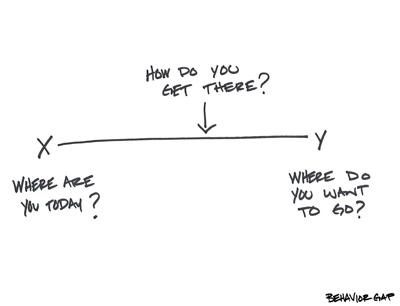
According to Mike, when you find yourself stuck, sidelined, entrenched, and just spinning those proverbial wheels, it helps to take a little time and reorient yourself (and maybe your business). To get over that hurdle, ask yourself three deceptively simple questions:
First, identify where you want to be. Be specific. Whether it’s dollars or location or number of employees or profit margin. KNOW where you want to be.
Next, identify where you are in terms specific to where you want to be. If where you want to be is operating at a 25-percent margin, then where you are can't be “I have $10 million in sales.” Make sure that your goal and your starting position are relative — and relatable — to each other. (Remarkably, answering this question is often the most difficult part.)
Now, identify how you’re going to get there. Easy, right?
Of course not. But that really is the crux of every business plan ever put to paper. More importantly, if you take the time to answer these questions — in this specific order — you’ll find that it actually is easier than you thought it would be.
After all, finding the best route forward is much, much simpler when you know where you are and are absolutely sure where you want to go.
Now, if you’re NOT the decision-maker, this gets a little more complicated. You have the added dimension of not just knowing what to do, but convincing others that your path is the righteous way.
As a consultant, I had it relatively easy. After all, these decision-makers were paying me by the hour to solve their problem. But what if it’s a problem you’ve identified, and your boss hasn’t?
This is the second reason I believe “Plan the work then work the plan” doesn’t happen.
In this case — which happens far more frequently than anyone is willing to admit — Mike’s approach needs a couple extra steps.
In addition to answering those three basic questions, you need to put the third question into a step-by-step outline that lays out a clear and direct path forward. And you need to highlight the impact that following — and not following — your recommendations will have.
Finally, for the non-decision-maker, you have to set aside pride-of-ownership.
At this point, you’ve planned the work, and you’re ready to work the plan. Now you have to accept that the boss is going to change the plan. And that’s fine. It is, after all, the boss's decision to make. It’s the boss's goals you’re ultimately striving to achieve, right?
If you’ve given them enough to work with, your effort will serve as entrepreneurial inspiration. You will have kick-started their intuition, guts, instinct, whatever, and shifted things back into forward momentum.
So work that plan.
•••
Don't let Jeffrey M. Peyton's accolades, business accomplishments or cool demeanor fool you. The Sun's newest marketing team member has wing-walked on an airplane at 700 feet, co-piloted the Goodyear Blimp, swam with sharks, and managed to obtain paperwork officially declaring him “legally sane.”
(0) comments
Welcome to the discussion.
Log In
Keep it Clean. Please avoid obscene, vulgar, lewd, racist or sexually-oriented language.
PLEASE TURN OFF YOUR CAPS LOCK.
Don't Threaten. Threats of harming another person will not be tolerated.
Be Truthful. Don't knowingly lie about anyone or anything.
Be Nice. No racism, sexism or any sort of -ism that is degrading to another person.
Be Proactive. Use the 'Report' link on each comment to let us know of abusive posts.
Share with Us. We'd love to hear eyewitness accounts, the history behind an article.