




European hedgehog on top of some leaves. (Tine Reinholt Jensen via SWNS)
By Stephen Beech
Hedgehog road deaths could be reduced using ultrasound technology, according to new research.
Ultrasound-repellers would cut the huge number of the nocturnal mammals killed by cars, say Oxford University researchers.
The proposal is based on their findings which show for the first time that hedgehogs can hear high-frequency ultrasound.
The European hedgehog is one of Britain's best-loved mammals.
But experts say populations are in "grave" decline with the species classed as “near threatened” by the International Union for Conservation of Nature (IUCN) in 2024.
A major cause of hedgehog deaths is road accidents, which are thought to kill up to one in three hedgehogs.

Dr. Sophie Lund Rasmussen and a hedgehog. (Joan Ostenfeldt via SWNS)
The new study, published in the journal Biology Letters, suggests that ultrasound-repellers could be used to deter hedgehogs from roads, reducing the number killed by cars.
It wasn't previously known whether hedgehogs could hear that sound range.
Lead researcher Doctor Sophie Lund Rasmussen said: “Having discovered that hedgehogs can hear in ultrasound, the next stage will be to find collaborators within the car industry to fund and design sound repellents for cars.
"If our future research shows that it proves possible to design an effective device to keep hedgehogs away from cars, this could have a significant impact in reducing the threat of road traffic to the declining European hedgehog.”
Oxford researchers worked with colleagues in Denmark to test the auditory brainstem response of 20 rehabilitated hedgehogs from Danish wildlife rescue centres.
The method uses small electrodes placed on the animals to record electrical signals travelling between the inner ear and the brain, while short bursts of sounds are played through a small loudspeaker.
The electrodes detected that the brainstem fired when signals were played across a range of 4-85 kHz, with a peak sensitivity around 40 kHz.

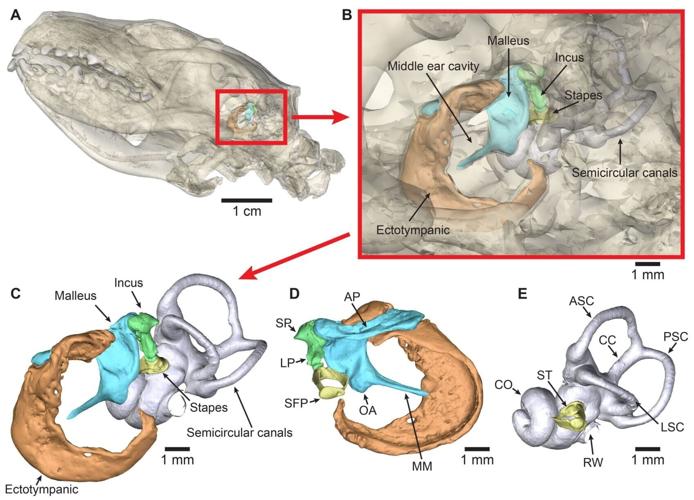
European hedgehog ear anatomy. (Rasmussen et al via SWNS)


That showed that hedgehogs can hear in the ultrasound range - which starts at frequencies greater than 20 kHz - up to at least 85 kHz.
After being checked by a vet following the experiments, the hedgehogs were released back into the wild the following night.
The research team also conducted high-resolution micro-CT scans of a dead hedgehog which had been euthanised after being critically injured by a rat trap.
The scans were used to build an interactive 3D model of the hedgehog’s ear, revealing features never seen before.
The model showed that hedgehogs have very small, dense middle-ear bones and a partly fused joint between the eardrum and the first of the bones.
The researchers explained that it makes the whole chain of bones stiffer, helping it pass very high-pitched sounds efficiently – a hallmark of animals, such as echolocating bats, that can hear ultrasound.
The scans also showed that hedgehogs have a small stapes - the smallest middle-ear bone that connects the chain of ear bones to the inner ear’s fluid-filled cochlea.
A smaller, lighter stapes can vibrate more quickly, enabling it to transmit high-frequency sound waves.
The cochlea was also found to be relatively short and compact, enabling it to better process ultrasonic vibrations.

Dr. Sophie Lund Rasmussen and a hedgehog. (Joan Ostenfeldt via SWNS)
The researchers say the results suggest that it would be possible to design ultrasonic repellents that can be heard by hedgehogs, but not humans or pets.
Humans can only hear in the range of 20 to 20,000 Hz, dogs 67 to 45,000 Hz, and cats 45 to 65,000 Hz.
If proved effective, the team say repellers could potentially be used to deter hedgehogs from roads and other potential threats, such as robotic lawnmowers and garden strimmers.
Dr. Rasmussen said: “Our novel results revealed that European hedgehogs are designed to, and can, perceive a broad ultrasonic range.
"A fascinating question now is whether they use ultrasound to communicate with each other, or to detect prey – something we have already begun investigating.”
Co-author Professor David Macdonald, also from the University of Oxford, said: “It is especially exciting when research motivated by conservation leads to a fundamental new discovery about a species biology which, full circle, in turn offers a new avenue for conservation.."
He added: "The critical question now is whether the hedgehogs respond to ultrasound in ways that might reduce the risks of collisions with robotic lawnmowers or even cars."


(0) comments
Welcome to the discussion.
Log In
Keep it Clean. Please avoid obscene, vulgar, lewd, racist or sexually-oriented language.
PLEASE TURN OFF YOUR CAPS LOCK.
Don't Threaten. Threats of harming another person will not be tolerated.
Be Truthful. Don't knowingly lie about anyone or anything.
Be Nice. No racism, sexism or any sort of -ism that is degrading to another person.
Be Proactive. Use the 'Report' link on each comment to let us know of abusive posts.
Share with Us. We'd love to hear eyewitness accounts, the history behind an article.