


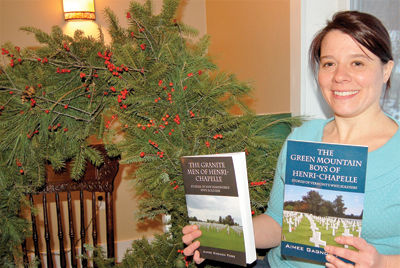
Aimee Fogg of Gilford holds copies of the books that have resulted from her work to research the backgrounds of the 40 New Hampshire and 25 Vermont servicemen who died while fighting the Nazis in World War II and were interred at the Henri-Chapelle American Cemetery in Belgium. (Bea Lewis/for The Laconia Daily Sun)
Gilford woman nurtures the living by honoring the dead
By BEA LEWIS For The Laconia Daily Sun
GILFORD — Six years ago, Aimee Fogg traveled to Belgium to learn the circumstances of her great uncle's death in World War II. With the assistance of a German veteran who fought against Allied troops, Fogg walked in the footsteps of her paternal grandmother's younger brother, Paul Lavoie of Nashua, who was killed in action on Feb. 10, 1945, in Schmidt, Germany.
Visiting his grave at the Henri-Chapelle American Cemetery in Homburg, Belgium, on Memorial Day 2010, proved cathartic for Fogg who realized that like her, many families did not know the details of their loved one's service and sacrifice, or even where they are buried. Today, she has a growing collection of adopted relatives after she decided to research and collect the stories and photos of the 39 other New Hampshire servicemen interred at Henri-Chapelle.
In 2013, "The Granite Men of Henri-Chapelle, Stories of New Hampshire's World II Soldiers" was published. In 2015, it was followed by "The Green Mountain Boys of Henri-Chapelle."
"These men have stories to share, voices to be heard, lives to be remembered and sacrifices to be honored," said Fogg. When she connects with surviving family members, Fogg said, many know little information other than their loved one was buried in Belgium. She does most of her interviews by telephone but also mails a questionnaire that gives them additional time to recall and reflect.
In researching Private Leroy Baker of Vermont, Fogg located his sister Cecile, who was adamant that they meet in person, so she and her family made the three-hour-long drive to Massachusetts. Baker's sister was waiting in the driveway when they arrived.
"She opened the passenger side door of the van and gave me a hug," Fogg said. "As she was hugging me, she said, 'I've been waiting 70 years for you."
The woman had saved a treasure trove of information about her brother.
"The project is not about the books. It's about them, because of them and for them," Fogg stressed. All of the information she gleans about soldiers buried at Henri-Chapelle is forwarded to the cemetery superintendent and placed in the soldier's individual file.
School children are frequently taken to the cemetery on field trips and are encouraged to walk among the sea of crosses and to pick an individual grave to learn more about the man who gave his life to turn back the tide of tyranny. Fogg said she is heartened to think her work is helping to allow those soldiers to continue to speak, helping the memory of the fallen to live on.
Her focus now is centered on collecting as many personal histories and photos of all 7,992 men who remain at Henri-Chapelle including 35 pairs of brothers, a trio of siblings from Tennessee, and two reporters. Fogg views the daunting task as a display of gratitude and appreciation for their sacrifice.
It is the moment that every military family dreads, when a service member's loved ones go from having a son or husband fighting in the war, to having a son or husband who became a casualty.
Fogg said in speaking with family members some recounted that their parents or grandparent's lives changed forever when the doorbell rang. Telegrams were the most common form of communication when notifying families. They were most often hand-delivered by couriers of Western Union, and followed a rigid format beginning with the dreaded words, "I regret to inform you..."
For many families, the sorrow of losing a son in the prime of life was so painful they never spoke of it. Fogg said a memory that many surviving family members have shared with her is that the family dogbegan acting odd, and refused to eat, within 24 hours of when the official death notification arrived. The stories are both heart-wrenching and heartwarming. Two pairs of Vermont brothers died within a week of each other on Dec. 14 and Dec. 21.
While some families opted for their loved one's remains to be sent home for reburial at war's end, Fogg said, others felt they should remain with their comrades in arms or feared an improper identification. One family told Fogg their parents had been unrelenting that there would be no stranger buried in the family plot.
"I call my project a celebration of life. The families always have the final say. I don't get into the battlefield specifies unless they want me to. Because it's about them, how they lived, not how they died," she said.
Most of the nearly 8,000 men who rest at Henri-Chapelle died fighting during the Hüertgen Forest campaign, the Battle of the Bulge, air operations over the region and in the Allied advance into Germany.
To increase public awareness about her project, Fogg founded "They Speak – Voices of Henri-Chapelle American Cemetery" and has created a website.
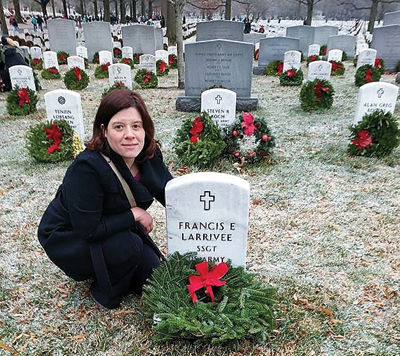
On Dec. 17, Fogg participated in Wreaths Across America at Arlington National Cemetery and visited SSGT Francis Larrivee's marker. A Laconia native, Larrivee is one of 40 New Hampshire men featured in her book, "The Granite Men of Henri-Chapelle."
A member of the Army Air Corps, he is one of 450 men listed as missing in action on a memorial at the cemetery in Belgium. His remains were uncovered in a German potato field and identified in 2005. His daughter Judith, opted for interment at Arlington. Larrivee, who was a right waist gunner, is at Section 60 among his crewmates, whose remains have been identified.
Fogg said Michael Culver the director of the Wright Museum of World War II in Wolfeboro invited her to speak about her work last fall.
Through that talk, she met Mike Folan, a history teacher at Prospect Mountain High School in Alton. His students researched the backgrounds of 34 New Hampshire men interred at the Netherlands American Cemetery in Margraten. They presented their research at the museum in May, and are now working on a similar project researching Granite State soldiers at the Normandy American Cemetery and Memorial in France.
"This is a chance for them to all speak. They will never celebrate another Christmas, or Hanukkah, go to college, meet a child, or buy a house. People today don't seem to understand or grasp the hardships and sacrifices of World War II," Fogg said.
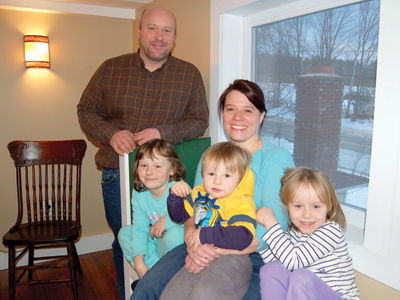
Aimee Fogg seated center, holds her son, Robert, 2, flanked by daughter Isabella, 6, left, Chapelle, 4, right, and her husband, Ryan, standing left. (Bea Lewis/for The Laconia Daily Sun)
On Dec. 16, Fogg participated in Wreaths Across America at Arlington National Cemetery. She is pictured at SSGT Francis Larrivee's marker. A Laconia native, Larrivee is one of 40 New Hampshire men featured in her book, "The Granite Men of Henri-Chapelle." A member of the Army Air Corps, he is one of 450 men listed as MIA on a memorial at the cemetery in Belgium. His remains were uncovered in a German potato field and identified in 2005. His daughter Judith, opted for interment at Arlington. Larrivee, who was a right waist gunner, is at Section 60 among his crewmates who remains have been identified. (Courtesy Photo)


(0) comments
Welcome to the discussion.
Log In
Keep it Clean. Please avoid obscene, vulgar, lewd, racist or sexually-oriented language.
PLEASE TURN OFF YOUR CAPS LOCK.
Don't Threaten. Threats of harming another person will not be tolerated.
Be Truthful. Don't knowingly lie about anyone or anything.
Be Nice. No racism, sexism or any sort of -ism that is degrading to another person.
Be Proactive. Use the 'Report' link on each comment to let us know of abusive posts.
Share with Us. We'd love to hear eyewitness accounts, the history behind an article.