


It’s early spring in New Hampshire with snow still lingering at the higher elevations in the White Mountains, but the migratory birds are already arriving to start their summer life in the Lakes Region. The seacoast gets a lot of attention in migration season but our inland lakes have plenty of bird action as well, both migratory birds stopping for a rest and a meal on their way north, as well as our local residents that will spend the summer here. Water fowl seem to be first to arrive, appearing as soon as small bits of open water appear in the lakes. Mallards, buffleheads, and mergansers are often seen at this early part of the season, as soon they can find food in the cold but open waters of our lakes and streams. Most song birds such as warblers and flycatchers will come later when the insects start to hatch out. Flycatchers in particular will make their way north following the insects as they hatch, arriving in the Lakes Region in time for black fly season to take advantage of that plentiful high-protein food source along with all the other insects that will hatch out. We may detest those biting bugs, but think how bad they would be without our birds; a single flycatcher can consume over a quarter million insects per year.
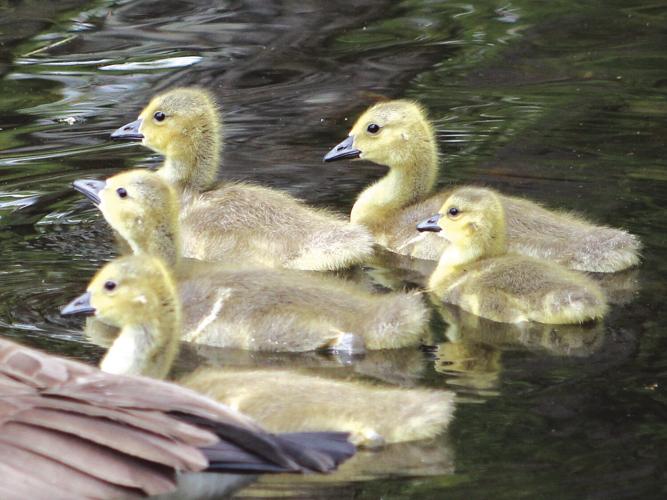
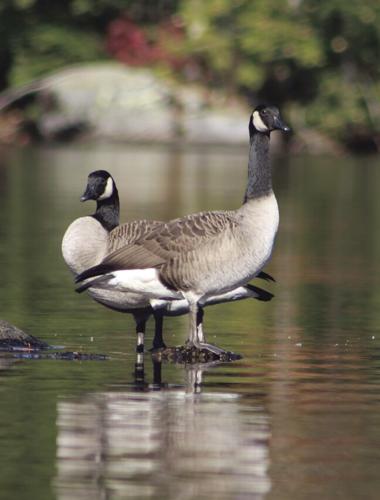
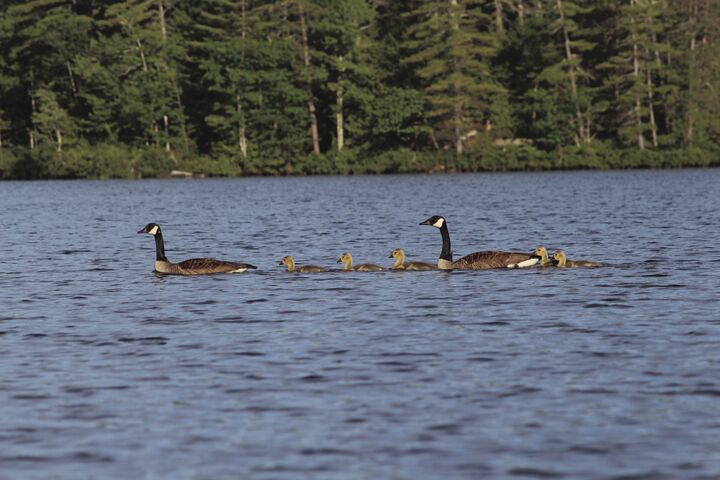
Some of the very first birds to appear in the spring are Canada geese. I’m always amazed to see them on the lakes long before ice out, wandering around on top of the ice like lost hikers. It must be an indication of their strong determination to breed for them to leave their warm and sunny winter homes to head north to New Hampshire at this time of year, but it’s the goose version of the early bird gets the worm. In this case, it’s the early goose gets the nesting site. The first geese to arrive will stake out the best nesting sites, driving away other birds that may want to nest there. It can get quite noisy as dozens of geese honk and squawk at each other defending and attacking the most desirable nesting sites.
In a few weeks the fighting will have subsided as each pair of geese will have secured a site or moved on to another location. By the middle of May they will have completed their nest; the female does most of the construction, finishing it off with a nice soft layer of goose down for their soon-to-arrive goslings. She also does all the incubation while the male stands by on guard duty to protect the nest and keep away any threats. As most people have experienced, geese can be very aggressive in defending their nests and their young, honking, hissing, and sometimes charging at intruders, including humans.
Geese prefer to build their nest in a secluded area near the water’s edge but with a good view in all directions. The female on the nest will hold her head high to keep watch of her surroundings, but if the male is away and she detects a threat she’ll do her best to hunker down hoping the threat passes by without noticing her. Still, there are plenty of predators that will happily drive her off and take her eggs if they find the nest: raccoons, weasels, bears, snakes, foxes — everyone likes eggs for breakfast.
Canada geese are large, majestic animals, and healthy birds are quite impressive. However they can also be a nuisance as they can multiply to excessive numbers — each pair can produce up to eight goslings per year — and they can be a real problem in public areas and water bodies. Even with hunting taking two million geese each year in the United States the population continues to grow rapidly. The best approach for limiting geese populations near water is to provide a barrier between water and land because goslings can’t fly and need to walk to the water soon after hatching. An easy natural solution is to leave — or plant — native shrubs or tall, thick grasses along the shoreline as that will discourage the adults from nesting there. Another option is a low fence along the shore. And of course, feeding geese is strongly discouraged and in many places, prohibited.
It’s worth noting that there are now two populations of Canada geese: migratory birds and non-migratory birds. The later derived from humans repopulating areas that were decimated by over-hunting and loss of habitat in the early 1900s. These birds have adapted to year-round life in areas where food is available through the winter.
As spring progresses more and more of our summer avian visitors will be arriving. Keep a pair of small binoculars in your car or your backpack, and when your travels take you by open water or a marshy wetland, stop and see what’s out there. Soon our mergansers, wood ducks, ospreys, and loons will be here to brighten our summer days.
•••
Scott Powell lives in Meredith, visiting the forest and waters in the Lakes Region and the White Mountains. He is a Conservation Commissioner for the town of Meredith, on the board of directors of the Lake Wicwas Association, and a member of the Land Stewardship Committee at the Lakes Region Conservation Trust. He writes a weekly journal about nature in the Lakes Region at https://wicwaslake.blogspot.com/ You can contact him at scottpowellnh1@gmail.com.


(0) comments
Welcome to the discussion.
Log In
Keep it Clean. Please avoid obscene, vulgar, lewd, racist or sexually-oriented language.
PLEASE TURN OFF YOUR CAPS LOCK.
Don't Threaten. Threats of harming another person will not be tolerated.
Be Truthful. Don't knowingly lie about anyone or anything.
Be Nice. No racism, sexism or any sort of -ism that is degrading to another person.
Be Proactive. Use the 'Report' link on each comment to let us know of abusive posts.
Share with Us. We'd love to hear eyewitness accounts, the history behind an article.