



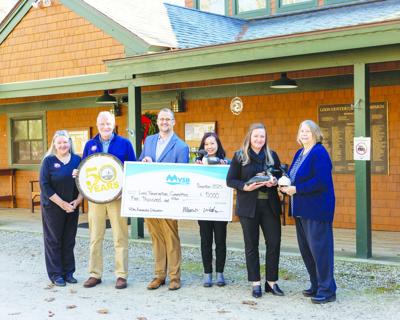
MEREDITH — Meredith Village Savings Bank is proud to support the Loon Preservation Committee in celebration of its 50th anniversary with a $5,000 donation to further the organization’s mission of protecting and restoring New Hampshire’s loon population.
“For 50 years, the Loon Preservation Committee has been a leader in wildlife conservation and environmental education in New Hampshire,” said Marcus Weeks, MVSB president. “Their work not only protects an important and beloved species, but also helps preserve the health of our lakes and ecosystems. We’re honored to support their efforts and celebrate this remarkable milestone with them.”
“MVSB’s generous support helps us continue our mission to safeguard loons and the habitats they depend on,” said Harry Vogel, senior biologist and executive director of the Loon Preservation Committee. “As we mark our 50th anniversary, we’re grateful for community partners who share our commitment to protecting New Hampshire’s loons for future generations.”
Founded in 1975, the Loon Preservation Committee works to restore and maintain a healthy population of loons throughout NH; to monitor the health and productivity of loon populations as indicators of environmental quality; and to promote a greater understanding of loons and the natural world. Through research, outreach and conservation initiatives, the Loon Preservation Committee continues to make a lasting impact on the health of New Hampshire’s lakes and wildlife.
In addition to the donation, MVSB has partnered with the organization to share facts about loons and the Loon Preservation Committee on Facebook and Instagram throughout the month of December.
• The Common Loon is the only loon species that breeds as far south as New Hampshire.
• Loons are expert divers and can stay underwater for up to five minutes while chasing fish.
• Their haunting calls serve as communication between mates and to defend territory.
• Loons are migratory, spending summers on inland lakes and winters along the ocean coast.
• A loon’s bones are much denser than those of most other birds, making them less buoyant and allowing them to dive as deep as 200 feet in search of food.
Visit loon.org to learn more.


(0) comments
Welcome to the discussion.
Log In
Keep it Clean. Please avoid obscene, vulgar, lewd, racist or sexually-oriented language.
PLEASE TURN OFF YOUR CAPS LOCK.
Don't Threaten. Threats of harming another person will not be tolerated.
Be Truthful. Don't knowingly lie about anyone or anything.
Be Nice. No racism, sexism or any sort of -ism that is degrading to another person.
Be Proactive. Use the 'Report' link on each comment to let us know of abusive posts.
Share with Us. We'd love to hear eyewitness accounts, the history behind an article.